 DaoAI
A little thank-you for sharing your experience.
A minute to tune in.
Notice where movement feels easy or stiff.
Pause whenever you like. Your arms can stay lower.
One movement / Your own pace
Let the hands lead.
Leave room to listen.
A small front-to-back wave, explored slowly. The invitation is to notice the effort, rather than reach a particular shape.
- Settle. Stand with feet hip-distance apart and knees soft. Begin with arms comfortably beside your ears and shoulders relaxed, or keep your arms lower if that feels easier.
- Let it travel. As your hands move gently forward, let the upper back ease back and the waist follow a little. Return at your own pace. Keep the movement small.
- Notice. Breathe normally. Where do you use more effort? You can make the movement smaller, pause, or leave it for another day.
A check-in with how movement feels, not a diagnosis. About the evidence ↗
Check-in / Optional
Where did
it feel stiff?
Your selections stay in this browser. Guide activity is counted in aggregate. Personal email links record the first visit and approximate country.
For your working day
Check your desk setup.
Explore the desk setup
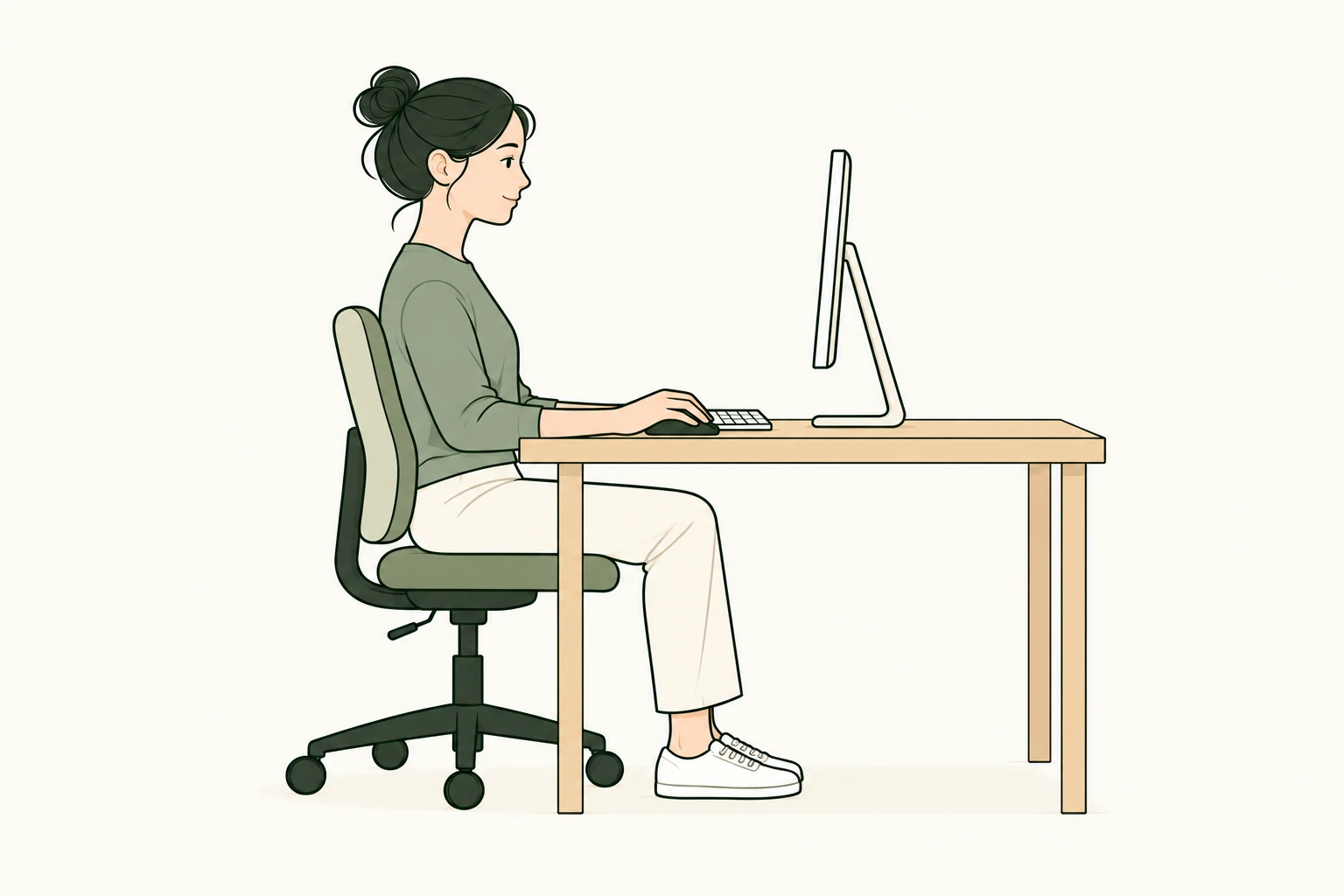
More about the setup
For prolonged laptop work, a separate keyboard and mouse let you adjust the screen independently. [2] [4]
For a fuller assessment, see the OSHA checklist ↗ or HSE checklist ↗, and discuss unresolved issues with a trained workplace assessor. These US/UK resources are not an Australian compliance assessment. [6]
A seated beginning
A little movement,
right in your chair.
Explore gentle circles in everyday clothes. Start with two minutes.
The idea behind the practice
In DaoAI, 筋柔骨正 expresses a practice ideal: supple movement with a sense of support. Here, the aim is simply to notice how the movement travels from your hands through your back towards your waist.
You may notice stiffness, ease, or extra effort. These are observations about your experience; they don’t identify the cause. Experiments involving people with chronic low back pain found that perceived stiffness did not track measured spinal stiffness. This does not establish what causes your own sensations. [10]
Keep it kind to your body.
Stop if movement causes pain, tingling or numbness. Ask your GP or physiotherapist about persistent or worsening symptoms. This guide is general education, not medical assessment or treatment. [8] [9]
For the curious / Sources & limits
Sources & context.
The desk prompts draw on public workplace guidance. The wave is a DaoAI teaching practice. The references below do not establish the effectiveness of this specific exercise. [7]
How this guide uses the evidence
The desk prompts are a short synthesis of workplace guidance, not a validated checklist or a complete ergonomic risk assessment. The linked OSHA and HSE tools are the original assessment resources.
The Cochrane work-break review concerns workers who were free of musculoskeletal complaints at enrolment. Its findings were very uncertain; it does not test DaoAI’s movement or establish a treatment for an existing back problem. [7]
The desk illustration and its dots are adjustable setup examples. Knee and elbow angles are starting points, not diagnostic thresholds. Screen-height recommendations differ across sources and may need adjustment for vision and task. Mayo Clinic also cites OSHA; these guidance sources should not be counted as independent clinical trials.
A 2018 Cochrane review found inconsistent evidence for alternative mice and arm supports in preventing neck or upper-limb disorders. Fit and comfort guidance is not a promise of symptom relief. [14]
A small 2016 laboratory trial studied hourly five-minute treadmill walks, not standing alone. It reported better self-rated mood and fatigue, but no significant improvement in cognitive performance; it did not establish spinal-health benefits. [15]
The wave is a teaching practice; the reflections are subjective. The references do not validate these as assessments of spinal anatomy or as treatment. The practice duration is a teaching choice, not an established therapeutic dose.
This is a general educational resource. No individual clinical or ergonomic assessment has been performed for a reader of this page. Listing a source does not imply its endorsement of DaoAI.
Source information last checked: 1 November 2026.
Read the references 15 references
- Safe Work Australia. Setting up your workstation (2023, PDF) ↗
Australian guidance on support, reach, screen setup and varying position. A starting point to adapt to the person and task.
- US Occupational Safety and Health Administration. Computer Workstations: Evaluation Checklist ↗
Cross-check for feet, backrest, input devices, viewing comfort and changes of activity. Its companion Good Working Positions ↗ gives the 90–120° elbow range and examples of upright sitting and position changes.
- Comcare. Computers and workstations ↗
Australian guidance on equipment adjustment, relaxed shoulders, comfortable reach and individual vision needs.
- UK Health and Safety Executive. Good posture when using display screen equipment (2025) ↗
Workstation and prolonged laptop-use guidance; cross-checked with the Australian and OSHA sources.
- UK Health and Safety Executive. Work routine and breaks (2025) ↗
Frequent breaks or changes of activity; timing depends on the work. This does not validate DaoAI’s exercise.
- UK Health and Safety Executive. Workstations and assessment (2025) ↗
Explains trained-assessor review and follow-up, with a link to the CK1 workstation checklist (2013) ↗. The checklist is a workplace assessment aid, not a clinical screening tool.
- Luger T, Ferenchak SA, Rieger MA, Steinhilber B. Work-break interventions for preventing musculoskeletal symptoms and disorders in healthy workers ↗
Cochrane Database of Systematic Reviews. 2025;10:CD012886. doi:10.1002/14651858.CD012886.pub3. PubMed record ↗. Evidence certainty is very low; this review does not test DaoAI’s practice.
- NHS. Back pain (reviewed 2026) ↗
When to stop exercises, seek advice and obtain immediate medical attention.
- healthdirect Australia. Back pain — an overview ↗
Australian advice on symptoms and when to seek medical care.
- Stanton TR, Moseley GL, Wong AYL, Kawchuk GN. Feeling stiffness in the back: a protective perceptual inference in chronic back pain ↗
Scientific Reports. 2017;7:9681. doi:10.1038/s41598-017-09429-1. This experimental study involving people with chronic low back pain and healthy controls distinguishes perceived stiffness from measured mechanical stiffness. PubMed abstract ↗. It does not validate DaoAI’s movement or establish the cause of a reader’s symptoms.
- Mayo Clinic Staff. Office ergonomics: Your how-to guide (2023) ↗
Medical-organisation educational guidance on feet, back support, neutral wrists, monitor height and position changes. It cites OSHA guidance; it is not an independent trial validating exact posture angles.
- US Occupational Safety and Health Administration. Pointer/Mouse: selection, placement and settings ↗
Guidance on hand fit, light grip, neutral wrist position and keeping the mouse close. The purchasing guide ↗ lists vertical mice and other alternatives, chosen for the user and task.
- US Occupational Safety and Health Administration. Work Process and Recognition ↗
Its Micro Breaks or Rest Pauses section suggests a five-minute break from computer tasks each hour, including looking away, standing or walking. This is ergonomic guidance, not a proven treatment dose.
- Hoe VCW, Urquhart DM, Kelsall HL, Zamri EN, Sim MR. Ergonomic interventions for preventing work-related musculoskeletal disorders of the upper limb and neck among office workers ↗
Cochrane Database of Systematic Reviews. 2018;10:CD008570. doi:10.1002/14651858.CD008570.pub3. Results for arm supports and alternative mice were inconsistent; they do not establish that every product marketed as ergonomic prevents pain.
- Bergouignan A, et al. Effect of frequent interruptions of prolonged sitting on self-perceived levels of energy, mood, food cravings and cognitive function ↗
International Journal of Behavioral Nutrition and Physical Activity. 2016;13:113. A small randomized crossover laboratory trial of hourly moderate-intensity treadmill walking. Mood and fatigue findings do not establish cognitive improvement, benefits from standing alone, or spinal-health outcomes.